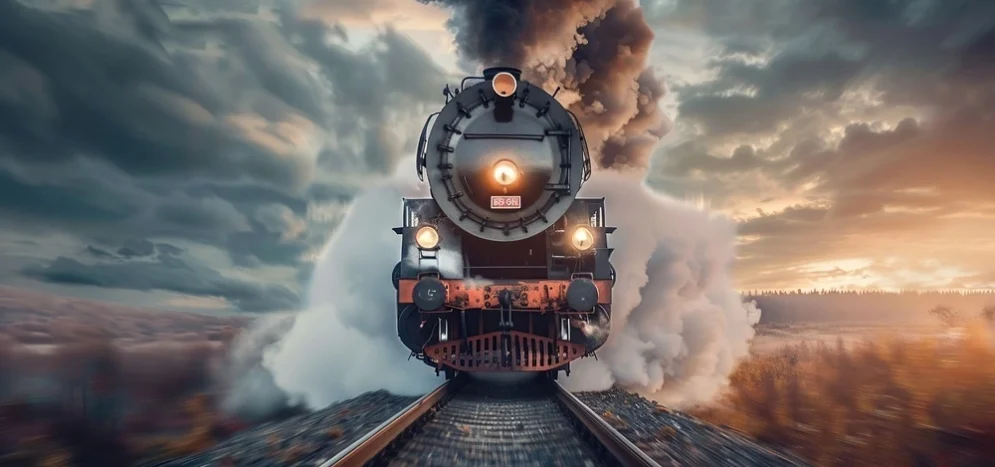
If the Baureihe 44 stood for raw power, then the Baureihe 50 embodied something equally decisive: reliability in daily operations. Few steam locomotives were as omnipresent in Germany and large parts of Europe as this one.
The BR 50 was no exceptional phenomenon, no specialized tool for extreme cases. It was everywhere – on main lines, branch lines, in marshalling yards and at small rural stations. That is precisely where its historical significance lies.
Developed for Flexibility
The Baureihe 50 was created in the late 1930s with a clear objective: to build a powerful yet versatile freight locomotive. It needed to haul heavy loads without being excluded from lines with low axle loads or from infrastructurally weaker regions.
The result was a locomotive that was technically well-balanced, robust, and comparatively easy to maintain – qualities that enabled its use over many decades.
Engineering for Everyday Service
Unlike specialized high-performance locomotives, the BR 50 took a pragmatic approach:
- Two-cylinder drive for simple maintenance
- Moderate axle load for use on virtually all lines
- Sufficient tractive effort for the majority of freight traffic
This combination made it the ideal locomotive for everyday operations – powerful enough for heavy trains, yet flexible enough for almost any route.
A Mirror of Its Time
The history of the Baureihe 50 is closely intertwined with the upheavals of the 20th century. It was built in large numbers, deployed during the war, and remained indispensable afterward.
After 1945, it was equally present in East and West. Both the Deutsche Bundesbahn and the Deutsche Reichsbahn were shaped by its image in freight operations for decades. In many regions it remained in service well into the 1970s – often as the last steam locomotive on the line.
The Locomotive of Small Stations
While express locomotives were photographed mainly in major cities, the BR 50 appears frequently in a very different setting: small stations, rural lines, unassuming halts.
That is precisely why photographs of the Baureihe 50 are of particular documentary value today. They show not only machinery, but landscape, architecture, and everyday life away from the major trunk routes.
The BR 50 tells railway history at eye level.
The Baureihe 50 in the Archive
In the archive, the Baureihe 50 represents continuity. The normal, day-to-day operations that formed the backbone of the railway system.
Our images are accompanied by detailed metadata: location, time period, train type, line profile, and historical context. This makes visible just how versatile this locomotive was – and why it remained indispensable across so many regions.
The breadth of images makes it possible to trace developments: technical changes, regional characteristics, and the gradual farewell to the steam locomotive.
Why the BR 50 Still Fascinates
The fascination of the Baureihe 50 lies not in the extraordinary, but in the familiar.
It stands for:
- reliability in daily operations
- regional diversity
- the unspectacular yet indispensable work of the railway
Those who study the BR 50 look at the foundation of everyday railway life – at what worked, day after day, decade after decade.
Conclusion
The Baureihe 50 was not a locomotive of headlines. It was the locomotive of everyday life. For that very reason, it is a key to understanding European railway history. Its images show how railways were truly lived – beyond prestige and records.